MARKET SHIFT / 01 OF 08
From horse and buggy to connected mobility
The first transition was bigger than the vehicle. The next one is, too.
01 / THE TRANSITION
What changed
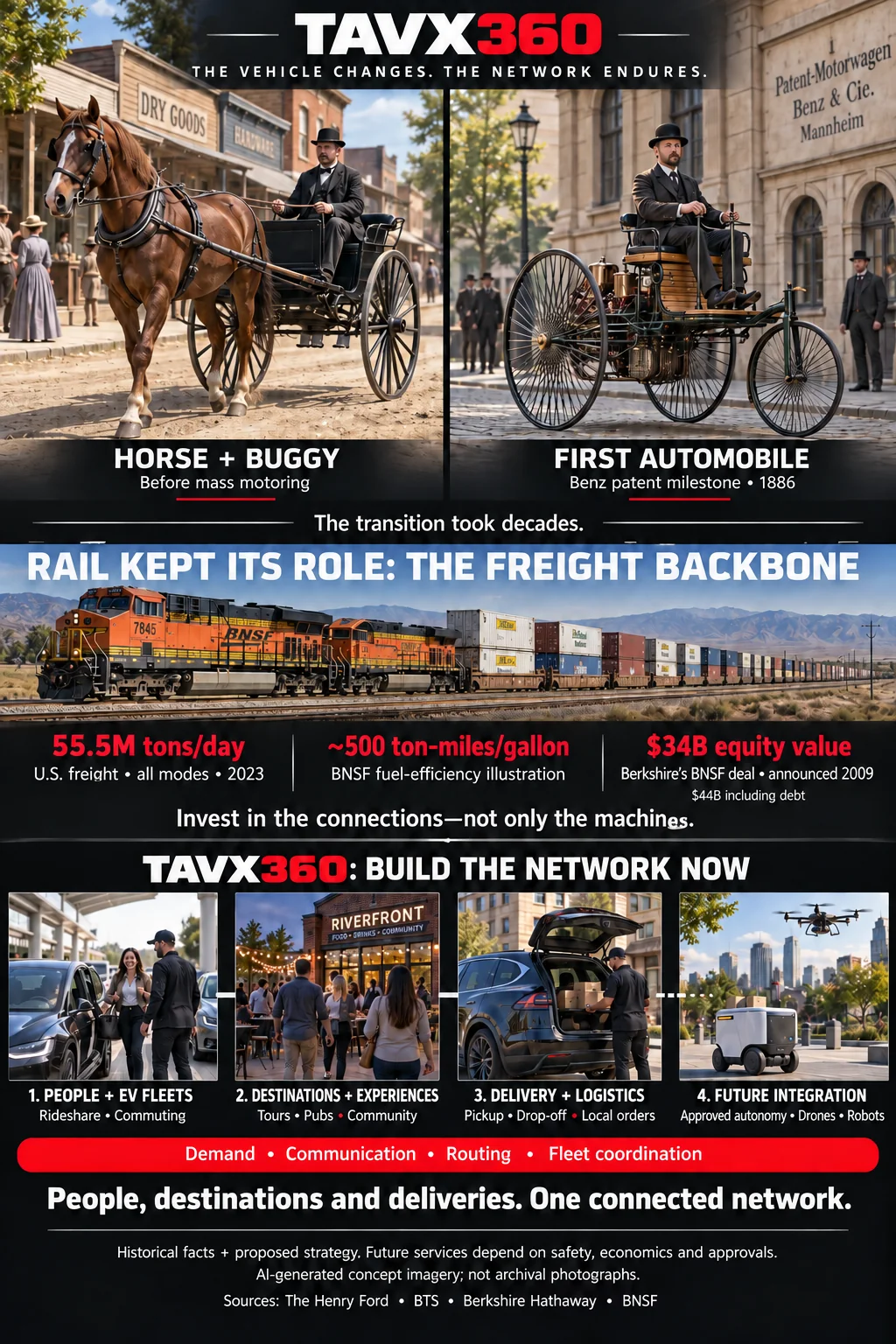
Horse-drawn travel depended on animals, feed, stables, harnesses, carriage repair, and the people who organized them. Motor vehicles required a different support system: fuel, mechanical service, roads, parking, and new operating skills. The important transition was the replacement and adaptation of an entire service chain.
The infographic connects this history to today’s network question. A vehicle provides movement; a functioning network makes that movement accessible, repeatable, and useful. Its historical imagery explains the mechanism of change. It does not establish an investment return.
02 / THE TRANSITION
The plates moving today
Vehicles are electrifying while property owners, utilities, service providers, and customers adapt at different speeds. A car can be delivered before its charger is energized. A parking agreement can be signed before sufficient customers commit. These mismatches are where coordination becomes valuable.
TAVX360’s opening is to connect an actual trip requirement to an actual site and an operating service. A commute circuit, an employer agreement, or a rental pickup location is a smaller, testable proposition than a promise to transform a whole city.
03 / THE TRANSITION
Small opportunities with a clear customer
Start with a property assessment, a reserved pickup area, charging access, or a recurring customer group. Each can become a defined service with an accountable operator. Schools, employers, and venue partners need different agreements; one generic model will not fit them all.
An assessment should identify who pays, what permission is needed, who owns the equipment, and what happens when demand is below plan. The coordination fee, vehicle revenue, and charging revenue should remain visible as separate lines.
04 / THE TRANSITION
Why the opportunity can persist
The underlying need to reach work, services, and social activities remains. The method of meeting it changes. Our thesis is that relationships and reliable operations can retain value across vehicle generations. That thesis holds only where customers use and pay for the service.
A site with repeat demand and a workable lease is more useful than a large inventory of vehicles without bookings. plan one circuit before adding another. Measure paid trips, repeat customers, wait times, operating cost, and contribution after direct expenses.
05 / THE TRANSITION
Our execution window
The time and capital required to retool manufacturing creates the opening behind our strategy. As manufacturers establish new production capability, we expect competition for customers, locations, and partners to intensify. Secure your position while that transition is underway.
Move now by selecting your role, developing your fleet plan, and beginning the agreements that connect your business to the network. TAVX360 provides customized strategy and white-glove coordination through the process. Our thesis is that an early position committed to someone else may never become available to us again.
Primary sources
Sources support the factual context; TAVX360’s commercial interpretation is explained separately above.