MARKET SHIFT / 03 OF 08
Transportation: utility, commodity, and leisure
Three service roles. Different customer expectations. One coordinated operating network.
01 / THE TRANSITION
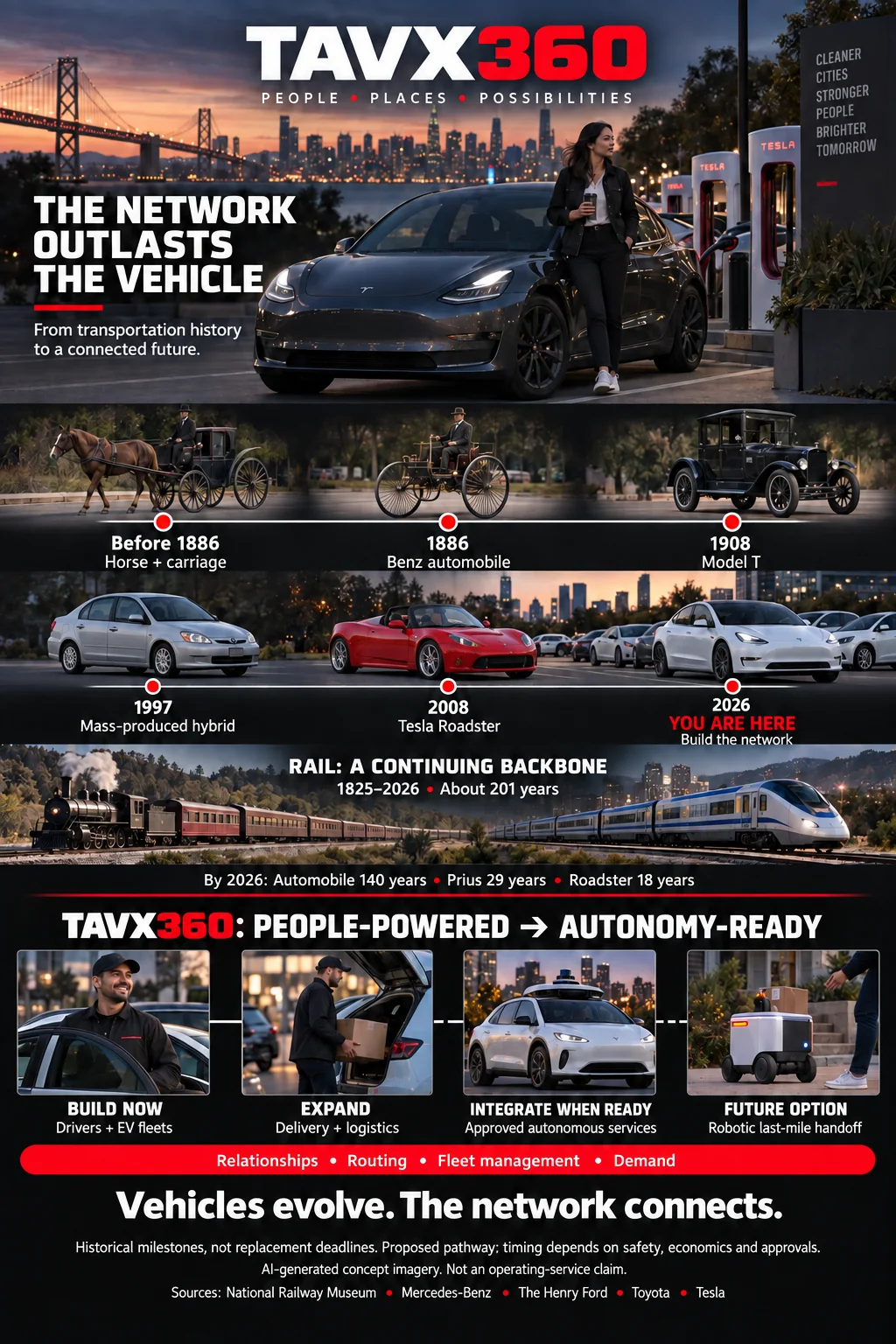
What the infographic is saying
The history places successive road vehicles alongside continuing rail networks. Its central idea is continuity of connection: people still need to move between places even as the equipment changes. Rail and road services can complement one another rather than follow a single replacement sequence.
For TAVX360, this is a design principle. The system should organize access to destinations and services without depending on one vehicle model forever. Vehicle ownership, infrastructure ownership, and customer coordination are related but distinct functions.
02 / THE TRANSITION
Layer 01 — Transportation as a utility
Everyday transportation delivers dependable access to work, education, shopping, and services. Here, utility describes its role in daily life, not a claim that TAVX360 is a regulated public utility. The customer needs predictable availability, a useful route, and a price they can sustain.
A recurring commute circuit or employee transport arrangement is a practical starting point. Measure on-time performance, repeat bookings, paid occupancy, and the cost of maintaining reliable availability.
03 / THE TRANSITION
Layer 02 — Transportation as a commodity
When competing trips look interchangeable, customers compare price, availability, and convenience. The strategic premise is that some routine trips become increasingly standardized and face price pressure. The operator must earn a margin through disciplined costs and useful capacity rather than assume premium pricing.
Coordination can help match demand and reduce avoidable idle time. It cannot guarantee full cars or eliminate empty return journeys. Test the actual cost per completed paid trip and the customer’s acceptable wait and detour.
04 / THE TRANSITION
Layer 03 — Transportation as leisure
Leisure transport connects people to experiences: events, outings, travel, and premium member services. Customers may pay for comfort, a curated itinerary, flexible service, or convenience. This is a different offer from a standardized commute.
TAVX360 can build venue partnerships and optional premium packages around those needs. Price the additional service and account for its delivery cost. A vehicle cannot serve a leisure booking and a commute booking at the same time; use a real operating calendar.
05 / THE TRANSITION
The site is an operating interface
A station-adjacent parking lot can connect public transport, pickup, rental access, and charging. Those uses need defined spaces and schedules. Commuter parking cannot be assumed to be available for unrestricted commercial activity simply because a stall appears empty.
Begin with ownership, permitted use, accessible circulation, electrical capacity, and the host’s approval process. The agreement should describe charging customers, reserved fleet spaces, pickup activity, operating hours, maintenance, and revenue allocation.
06 / THE TRANSITION
The opportunity in relationships
A property partner supplies location and permissions. An employer or membership organization can supply recurring demand. An operator supplies dispatch, service quality, and accountability. The value comes from making these commitments work together.
Offer a bounded launch: a specified number of stalls, a defined circuit, and an agreed review period. Give the host a dashboard showing usage, revenue, service incidents, and its share. Avoid converting a potential partnership into a claim of secured business.
07 / THE TRANSITION
Why the network thesis holds conditionally
A well-used location can support several services over time. Customer trust and operating records can make the next deployment easier. These are the durable parts of the thesis; vehicle appreciation and speculative future autonomy are not required to explain them.
Durability depends on contract rights, reliable service, and customer retention. If a lease can be cancelled, a route has little paid demand, or charging margins are negative, the network has not yet become a defensible asset.
08 / THE TRANSITION
What to secure before 2030
The time and capital required to retool manufacturing creates the opening behind our strategy. As manufacturers establish new production capability, we expect competition for customers, locations, and partners to intensify. Secure your position while that transition is underway.
Move now by selecting your role, developing your fleet plan, and beginning the agreements that connect your business to the network. TAVX360 provides customized strategy and white-glove coordination through the process. Our thesis is that an early position committed to someone else may never become available to us again.
Primary sources
Sources support the factual context; TAVX360’s commercial interpretation is explained separately above.