MARKET SHIFT / 05 OF 08
Powertrain report: the shift beneath the surface
The urgency layer — secure a position while manufacturers retool and the support network resets.
01 / THE TRANSITION
The urgency: an early position can close permanently
Our strategic thesis is direct: this early positioning window can close for us if we wait while manufacturers retool and competitors secure the sites, customer relationships, and operating partnerships. A particular lease, exclusive agreement, or first operating position may never be available to us again.
The opportunity is to participate while the support network is still being organized. Act by identifying a real customer, securing workable site rights, and delivering a paid service. The thesis does not establish a universal date when the entire market closes forever.
02 / THE TRANSITION
What is changing beneath the surface
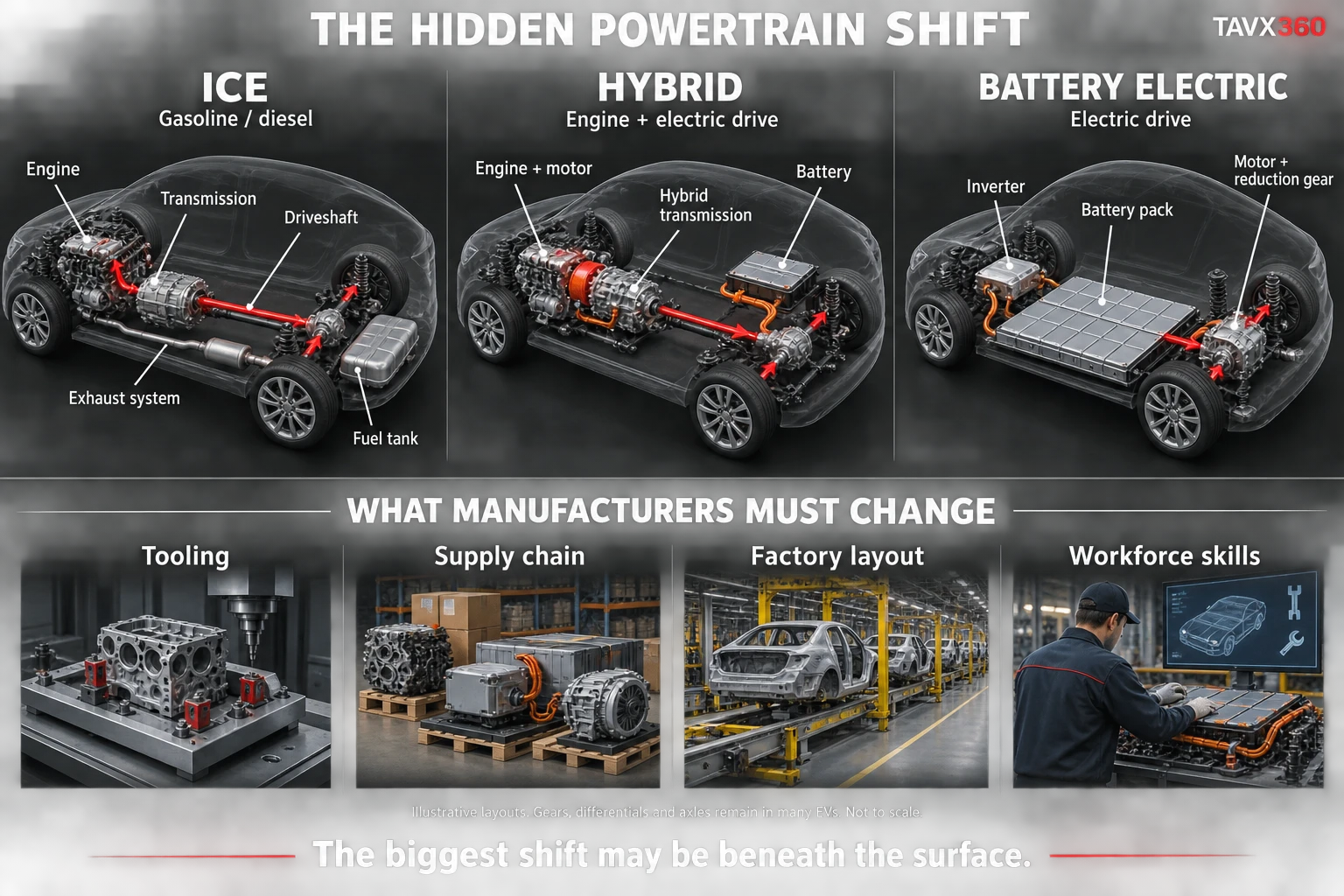
A combustion vehicle organizes propulsion around an engine, fuel system, exhaust, cooling, and a transmission. A hybrid combines combustion and electrical systems. A battery-electric vehicle centers propulsion on a battery, power electronics, and electric motors, with its own thermal management and charging requirements.
The infographic makes this less-visible transition understandable. EVs still have mechanical components, including reduction gearing and other drivetrain parts depending on design. The shift is a different architecture and service chain, not the disappearance of all moving parts.
03 / THE TRANSITION
Why retooling matters
A factory cannot always make a new propulsion architecture by changing its advertising. Assembly processes, tooling, component supply, software integration, quality checks, and workforce skills may need to change. Manufacturers make different choices about what to convert, keep, outsource, or discontinue.
This creates a period of overlap. Existing combustion vehicles remain in use while new EV capacity and support systems develop. Some businesses can adapt; others face capital and capability gaps. The opportunity lies in identifying a specific unmet need during that overlap.
04 / THE TRANSITION
Five plates moving at different speeds
The first plate is the vehicle: product cost, range, and customer fit. The second is manufacturing: factories, suppliers, and skills. The third is energy and property: electrical capacity, charging, parking rights, and construction. The fourth is software: bookings, diagnostics, routing, and payments. The fifth is commercial permission: agreements, insurance, operating rules, and customer demand.
A gap appears when one plate moves ahead of another. Vehicles may arrive before charging is ready. A site may have electricity but no repeat customers. A membership organization may have demand but no reliable service. TAVX360 can coordinate these gaps when the work has a buyer and a viable delivery cost.
05 / THE TRANSITION
Where a smaller business can participate
Start with site assessments, fleet charging plans, customer onboarding, rental logistics, maintenance coordination, or contracted recurring trips. These are distinct offers. An assessment can be sold before a large fleet is acquired; a charging-management contract can operate without owning every vehicle.
Separate consulting fees, infrastructure returns, and mobility revenue in the records. Show the equipment owner, site host, operator, and customer relationship explicitly. Multiple entities do not remove eligibility rules or create additional grant entitlement for the same project.
06 / THE TRANSITION
Why the opportunity can hold steady
Our thesis is that the support system takes time to adapt even while vehicle technology advances. That can sustain demand for capable local coordination. It does not mean every EV service earns a margin or that charging demand is guaranteed at an unused lot.
The thesis strengthens when there are written host agreements, repeat paid bookings, feasible power, manageable insurance and labor costs, and evidence of positive contribution. It weakens when the model depends on full occupancy, unawarded grants, or an assumed future capability.
07 / THE TRANSITION
The closing retooling window
The time and capital required to retool manufacturing creates the opening behind our strategy. As manufacturers establish new production capability, we expect competition for customers, locations, and partners to intensify. Secure your position while that transition is underway.
Move now by selecting your role, developing your fleet plan, and beginning the agreements that connect your business to the network. TAVX360 provides customized strategy and white-glove coordination through the process. Our thesis is that an early position committed to someone else may never become available to us again.
08 / THE TRANSITION
Your fleet launch plan
Before committing capital, identify the paying customer, secure the relevant site rights, confirm a deliverable service, and model revenue after all direct and fixed costs. Include financing, downtime, maintenance, insurance, energy, and the staffing required by the actual operating arrangement.
Build the base case around capabilities available and permitted today. Any future autonomous service should be a separate case with its own authorization and operating evidence. The hidden powertrain shift creates reasons to prepare now; it does not remove the need to establish the business.
09 / THE TRANSITION
Participation: build toward generational wealth
Generational wealth is the long-term ambition: build an enterprise with durable relationships, useful infrastructure rights, repeat demand, and operating capability that can continue beyond the founder. Participation should create lasting business value rather than depend on one vehicle generation.
Choose the role that matches your capabilities: site partner, assessment and coordination provider, fleet operator, or customer-service partner. Start with a defined agreement and accountable economics. Business ownership can create wealth, but participation does not assure a return; the enterprise must earn and retain value.
Primary sources
Sources support the factual context; TAVX360’s commercial interpretation is explained separately above.